Thursday, June 24, 2010

Dipangkorn students


Here you see the standard look of morning assembly; students like any others, gathering to chat, laugh, poke each other, generally goof around. Then on a signal from a teacher (via loudspeaker), students all form even ranks (arm's length distance between rows).


Students stand for the playing of a song for the flag-raising, a prayer to the Buddha shrine, a song for Thailand and a song for Dipangkorn, all sung by the whole student body, accompanied by the school military band.
Then on another signal, all sit for the duration of the assembly--the longest for me so far is an hour and a half. The students are cross-legged on the concrete; luckily for me I'm old and a teacher, so I get to sit on the steps. On the day it rained (see the wet pavement above), the students were not asked to sit, so stood for the entire (shorter than usual) assembly.
Note the uniforms, also the uniform hair length of the girls. Some variation of the hair length among the upper classwomen, but the uniform dress remains standard throughout. Boys all have short hair; it's called a "student haircut". On Wednesdays many students wear a boy scout or girl scout uniform, also very clean and neat, shorts for boys and knee-or-longer skirts for girls. Standard shoes for girls are slip-on Mary Janes; for boys black sneakers. Always easy to slip on and off, which they do for every class. Shoes also come off outside every temple, also for the internet cafe. In restaurants people generally wear their shoes.
You may wonder what it is to "wai". You see an example in the upper right, students in reverent attention during a reading. Throughout the day students greet each other and the teachers using the same motion: hands together in prayer-pose, thumbs and fingers extended, head bowed and thumbs brought to chin, lips, nose or forehead depending on the amount of reverence shown. Friends greet each other with a brief chin-high wai; monks are honored with thumbs to forehead; in between is an infinite spectrum based on age and position of the one doing the honoring and the one acknowledging it. To me it's reminiscent of the tip of a hat in America's olden days--think Jimmy Stewart or Cary Grant being gallant.
The wai is used all over Thailand, not just in school. You'll see it in restaurants, out on the street; even the sports announcers on TV wai to their viewing public.
People have asked me to compare Thai high school students to their American counterparts: "Surely American students are not as naughty as our students!" Impossible to answer with any clarity. Thai students can be boisterous, noisy, energetic--is that naughty? I have not witnessed any malicious teasing, spiteful looks or direct disobedience.
One thing that is surprising for me is the out-loud cooperation of the class as a whole. If a student doesn't understand a question or doesn't know the answer, fellow classmates become a vocal peanut gallery, shouting out the answer or helpful hints. That seems to be expected, tolerated behavior--as is rote, unison response when everyone knows the answer. It's then a gleeful shout, with louder volume indicating greater understanding.
So far I've noticed rapt focus in my English classes, even in those classes where I was warned: this class is very bad in English. They seem eager to understand this strange phenomenon of a person who doesn't know Thai but talks anyway.
I have substituted in American schools; not fair to compare my honored status here, protected by the other teachers and a novelty to the students. In general so far, it's far easier to teach the Thai students. I feel as if they have learned something they wanted to know in every class, and are eager to continue the process.

Tuesday, June 22, 2010

Wat Prat Kiaow


The giant demon (about 20 feet high, I'd guess) is one of eight (I think), anyway they stand in pairs facing away from the emerald buddha, to guard the inner area from any evil spirits or other dangers.
There's no way to describe the magnificent opulence of the whole outer area--at every step is a new source of visual wonder. A cloister-like courtyard has murals of the epic poems, every step and doorway is decorated, small pavilions house separate Buddha images, floors and ceilings are mosaics of tiles or glass or gold or mother-of-pearl.
The inner area where the Emerald Buddha resides is a place of reverence, thus off-limits for photography. It has a rich beauty all its own, more serene and elegant. The Emerald Buddha is actually made of a single large piece of jade (maybe three feet high?) He was rescued from a temple in rural Thailand after a fire, was a plaster buddha image and thus revered but not especially treasured. Then someone noticed that his nose showed a bit of green (so the story is told by our guide); they carefully chipped away the plaster to reveal the magnificent, translucent green buddha that we see today.
The Buddha is clad in a suit of 24-karat gold. The costume is ceremonially changed three times a year to the suit of each season (Winter, Summer, Rainy--read: Hot, Hotter, Wetter). We were able to see the Winter and Rainy suits on display; he currently wears the Summer suit. Traditionally the king is the changer of the Buddha's suit; the last few times the Crown Prince has taken over the fairly arduous task. I imagine the costumes are quite heavy; the guide said the range in cost is 1 million $, 1.5 million and 2.5 million and they are truly gorgeous.
Enough--I'm overwhelmed by sensory beauty, am just beginning to understand the Buddhist philosophy underlying it all.


9 temples


It's time to show you some of the beauty of the temples. Last Saturday I had the opportunity to see nine Buddhist temples in Bangkok.
My hosts were Moo's two daughters, Miao and Panh (my transliterations)--lovely young women, both devout Buddhists. I gather that the number 9 is a good goal for the number of temples to see in one day for optimum merit. I'm not sure whether they were consciously gaining extra merit by treating a stranger to the same experience, but for me it was wonderful!
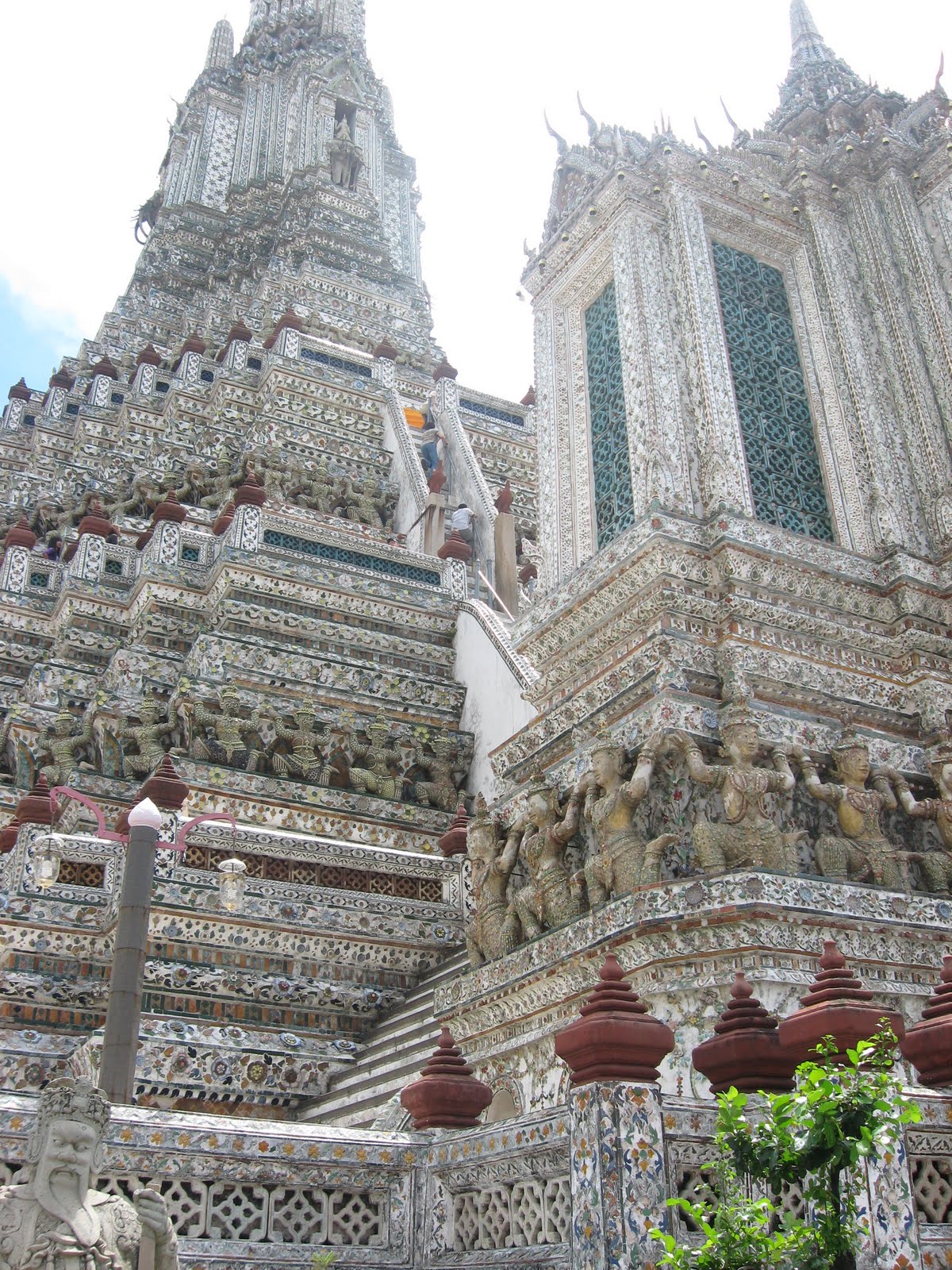
We walked a lot, ferried across the river several times, took a tuktuk ride, climbed the steps of the stupa at Wat Alun (the tall white one on the right). Those steps are very steep, by the way, about a 2 up/1 forward rise, even scarier coming down I think. An exercise in trust, and sore thighs at the end of the day.
We began the day at Wat Prat Kiaow, Temple of the Emerald Buddha--I'll give that a separate entry of its own, as it's also part of the Grand Palace, by far the most gorgeous of all the temples visually. Each temple has its own symbol, its own feel--Wat Pa Kang the temple of the bell, Wat Poh the temple of massage (didn't take time for a massage this day, will do that soon). The Reclining Buddha is huge and impressive. On first entry to the inner temple area, you see only the head, then proceed along to see shoulders, belly, thighs, shins, finally the feet--each glimpse a room in itself. The feet are amazing, decorated on the bottoms with elaborate mother-of-pearl images of buildings, flowers--each foot probably 4 feet high by 8 feet wide, a guess. As you look back along the whole length of the Buddha, awe is not an option; it's automatic. Same with the view from the top of the stupa, or the glitter of glass at Wat Prat Kiaow, or the smell of incense at the Chinese temple, or the clanging of the bells at Wat Pa Kang.
We sprinkled sacred water from lotus blossoms, received a blessing and bracelet from a monk, lit candles and incense sticks, poured oil into the receptacles in front of each day's special god-image, dropped satang coins into bowls, bought food for the monks (egg, bacon and a small cup of rice, all uncooked but ready to be presented to a monk for his day's food). We kneeled and bowed, and Miao prayed as I repeated the sounds. Took our shoes off to go into the inner temple areas (almost unbearably hot where the sun had already reached the marble surface!) Everywhere was reverence and ceremony, with different customs at each temple.
In a few of the temples they had separate entrance lines for native Thai people and for farang (foreigners); I'm guessing the farang entry cost more, which actually seems fair as for us it's a tourist attraction and for most Thais it's a religious observance. The two are so inextricably mixed--awe of Buddha and awe of the beauty to all senses.


Monday, June 21, 2010

new skills necessary to live in Thailand

It takes a village to teach a farang--This set of Thai letter stamps is apparently designed for first or second graders, worked well as an evening's entertainment--they stamped each letter in a page of my notebook (a gift from Boom), laughed and cheered as I copied the shapes. I know that learning to read will be a key to learning the language, feel discouraged sometimes at the daunting task.
Transportation is very different here! I applaud AFS for forbidding me to drive--just remembering as a pedestrian to watch for traffic driving on the opposite side of the road is enough challenge. This is the "red truck" that drives past the school and takes me out to the main road on the way to Phuttamonthon. It doesn't stop unless you flag it down (same with the bus; I waited patiently at the bus stop and watched two bus # 170s drive by before I figured out I'd need to be more assertive). Even then, the drivers of both truck and bus slow only to a semi-stop as people get on or off, no full stop unless in a traffic jam. You grab the bar at the back of the truck and swing on in, pay as you get off. Luckily I'm able to walk to school. I've decided I don't need a bicycle after all...

Climate control...


My schedule listed my first class as 236, took me a while to find it...


My new philosophy on fruit: watch someone else to figure out how to get into the edible part, then enjoy! Durian, by the way, is quite delicious, though it does indeed smell terrible. Other foods: surprising ingredients, such as dried fish in the sweet topping for sticky rice desserts, shrimp or oysters in the papaya salad, kernel corn in the ice cream; sweets tend to be way too sweet, spicy foods far too spicy, though there is often a less-spicy option, with the option to add sauces to taste. I watched one woman spoon on the hot pepper sauce til she elicited comment even from her fellow Thais; then she surreptitiously went back for more...


and you must see the flowers...


Anything goes for materials--fruits, flowers, leaves (folded artfully as you see here), popsicle sticks, pencils...


First Form students (grade 7) generally make fairly small and simple arrangements. By the time they're in Form 6 (12th grade), they can be quite elaborate.
Just as a note of contrast--the students who won the director's prize for knowing soccer trivia were just as proud as the winners of the flower judging.

more photos, teacher appreciation at Dipangkorn


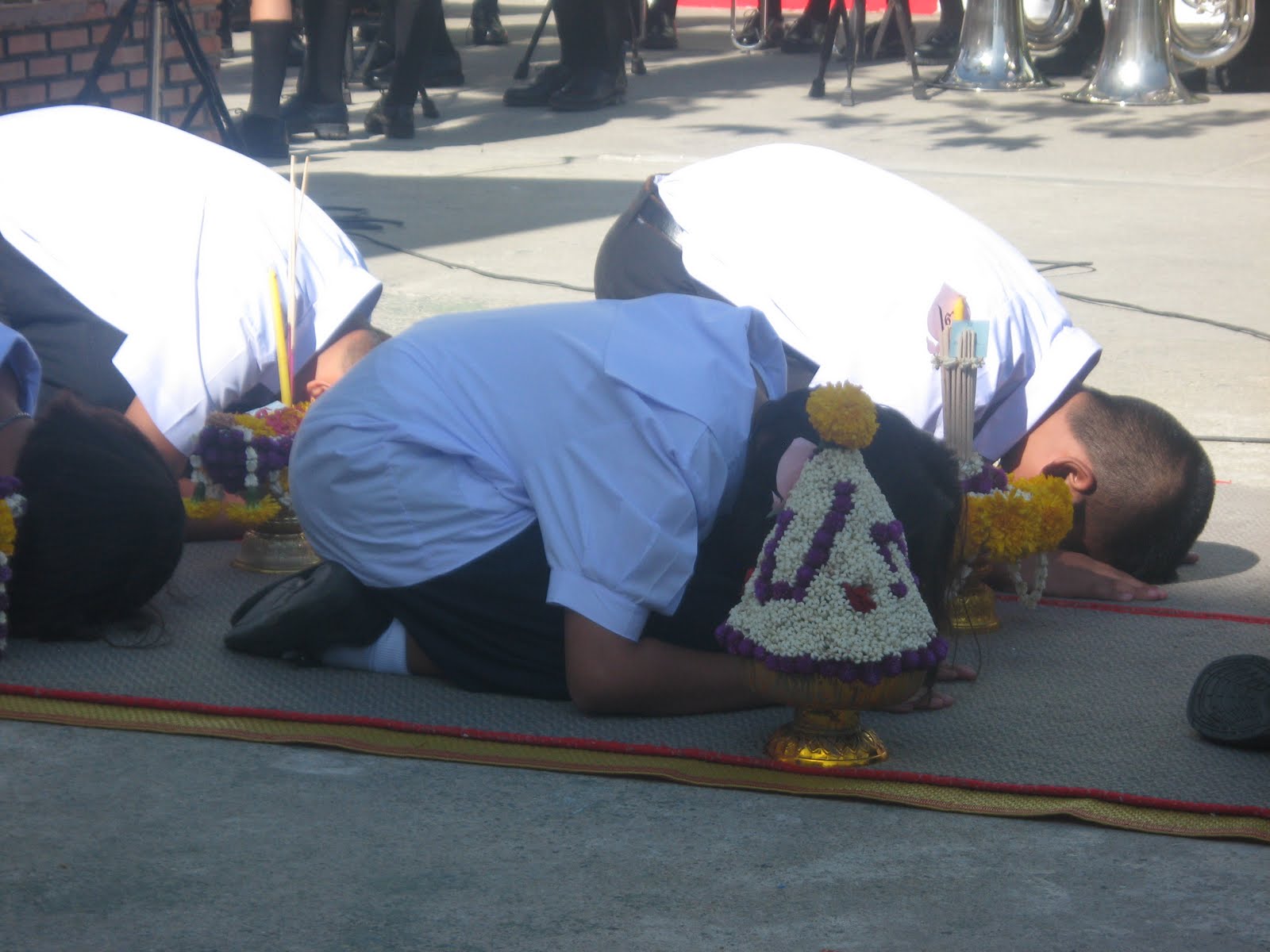
The monk is a teacher; I think he teaches Buddhist religion. The director, above right--presenting an award to a student. Teachers arrayed in preparation for the ceremony; a student reads as students show respect.


Teacher appreciation day

The finished product:
he drew the letters freehand--
one of the teachers--


This young man is also the
guard at the school, greets
people as they come in each
morning--


always takes one to supervise... Photos show inverse order of preparation; as you can see, it was all raw materials just the day before showtime...

Just look at the artistry going into these ceremonies!
Students spent 3 days preparing the floral arrangements for teachers, students and staff stayed after school to design and cut the styrofoam decor of the stage/platform, paint and assemble all to perfection.

The ceremonial process was also amazing--full of grace and dignity, also lots of laughter and fun.

I was privileged to sit in the front row of teachers at teacher appreciation day. Each student presented his or her own floral arrangement to us in the front row; we passed them back to the second row, who then passed them to the third row of teachers, who then placed the arrangements on the long table behind us all, where they were later judged and prizes awarded.